

Technoglitch
Core Member
When a GPU is virtualized for remote graphics, the GPU is shared among several users, just like a CPU was in the old time sharing days. A hypervisor manages the users and send jobs to the GPU. And it’s done on a load demand basis mostly. (The term "hypervisor" was most likely coined by Dave Tuttle at IBM in late 1971).
AMD says their Add-in-Boards (AIBs) are different and are equipped with special multi-user technology embedded into the GPU, and through its use it can deliver consistent and predictable performance. When appropriately configured (to the needs of an organization), end users get the same access to the GPU regardless of their workload. Each user, says AMD, is provided with the virtualized performance to design, create and execute their workflows without any one user tying up the entire GPU.
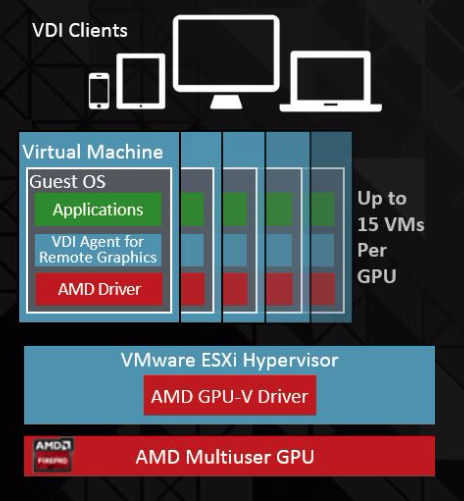
The multi-user GPU is designed to work in environments using VMware vSphere/ESXi 5.5 and up, with support for remote protocols such as Horizon View. Citrix Xen Desktop, Teradici Workstation Host Software and others. It uses VMware’s VIB driver with VMware certification, and AMD says no changes from pass-through are needed to run on vSphere/ESX 5.5 or vSphere/ESX 6.0. Other hypervisors with SR-IOV support can be enabled in the future.
Claiming to be created for GPU-accelerated workflows such as GPU compute and OpenCL, AMD says their approach is designed to overcome the limitations of software-based virtualization such as reduced end-user performance. The users, says AMD, have access to native AMD display drivers for OpenGL, DirectX and OpenCL acceleration, enabling work without restrictions.
AMD’s approach to specific GPU deterministic partitioning, rather than a dynamic load-balancing approach offered by Nvidia is bound to have adherents because AMD said they did it based on feedback they got from users. AMD claims their direct hardware solution offers better throughput, and tighter communications with the drivers and hypervisor, and points out one user cannot affect another user’s GPU performance.
AMD Says More Than One Way to Do Virtualization | EE Times
AMD says their Add-in-Boards (AIBs) are different and are equipped with special multi-user technology embedded into the GPU, and through its use it can deliver consistent and predictable performance. When appropriately configured (to the needs of an organization), end users get the same access to the GPU regardless of their workload. Each user, says AMD, is provided with the virtualized performance to design, create and execute their workflows without any one user tying up the entire GPU.
The multi-user GPU is designed to work in environments using VMware vSphere/ESXi 5.5 and up, with support for remote protocols such as Horizon View. Citrix Xen Desktop, Teradici Workstation Host Software and others. It uses VMware’s VIB driver with VMware certification, and AMD says no changes from pass-through are needed to run on vSphere/ESX 5.5 or vSphere/ESX 6.0. Other hypervisors with SR-IOV support can be enabled in the future.
Claiming to be created for GPU-accelerated workflows such as GPU compute and OpenCL, AMD says their approach is designed to overcome the limitations of software-based virtualization such as reduced end-user performance. The users, says AMD, have access to native AMD display drivers for OpenGL, DirectX and OpenCL acceleration, enabling work without restrictions.
AMD’s approach to specific GPU deterministic partitioning, rather than a dynamic load-balancing approach offered by Nvidia is bound to have adherents because AMD said they did it based on feedback they got from users. AMD claims their direct hardware solution offers better throughput, and tighter communications with the drivers and hypervisor, and points out one user cannot affect another user’s GPU performance.
AMD Says More Than One Way to Do Virtualization | EE Times
