

Technoglitch
Core Member
Free Basics, Facebook's non-profit initiative that aims to bring Internet connectivity to the underprivileged in developing regions, has run into trouble in India. Under Free Basics, Facebook is offering a range of services for free to thousands of users, but advocates and enthusiasts in the country are strongly encouraging users to discard Facebook's initiative. Why? 'Network neutrality' or 'net neutrality' is the reason - a concept that says a public network should treat all content, sites, and platforms equally.
It is around these questions that the net neutrality debate is raging across India and the world. In this article, we guide you through what net neutrality is, as well as the raging debate in India, while also pinpointing the developments that have taken place in this space.
But what is net neutrality?
The idea behind net neutrality is simple - treat all sites equally to give everyone a fair chance at growth, and reject the idea of monopolies. The term net neutrality was first coined by lawyer and scholar Tim Wu in 2003 in an academic paper also titled 'Network Neutrality, Broadband Discrimination,' which said that Internet service providers must treat all traffic on their networks equally.
"Network neutrality is best defined as a network design principle. The idea is that a maximally useful public information network aspires to treat all content, sites, and platforms equally. This allows the network to carry every form of information and support every kind of application. The principle suggests that information networks are often more valuable when they are less specialised - when they are a platform for multiple uses, present and future. (For people who know more about network design, what is just described is similar to the "end-to-end" design principle)."
So, what is Facebook's Free Basics?
First of all, it wasn't called Free Basics until September 2015. Formerly, it was known as Internet.org. The initiative is meant to provide free access to the Internet to the underprivileged in developing nations. Facebook has launched the initiative in 15 nations thus far, including India, where it debuted Internet.org in February this year in partnership with RCom, the fourth largest carrier in the country.
What's the problem with Free Basics?
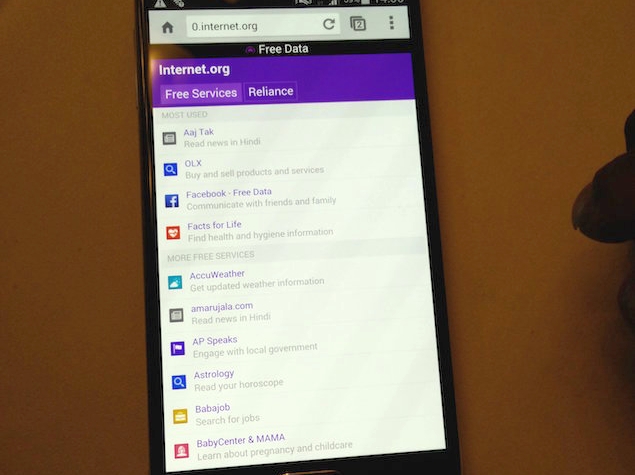
The bone that net neutrality activists have to pick with Free Basics is that it is a zero-rating platform, in that it provides free access to a limited number of services, but not to all. That it's not bringing unlimited access to the Internet to people, but access to a very small subset of the Internet. In India, for instance, the company with RCom was to offer access to 38 websites and services. These services included some news providers, some entertainment websites, and some infotainment websites, but each of their competitors was left out in the cold, with users having to continue to pay to access them. Reliance users across the country can access these pre-selected services for free, through this has now been put on hold following a directive issued by Trai.
But as we've pointed out before, Free Basics users can't access websites and services that aren't currently approved by Facebook. This approach defeats the basic fabric of net neutrality - Facebook defends itself on this front however, saying any websites and services can apply to be a part of Free Basics, while any telecom operator can offer it to their subscribers. It has also maintained that joining up is free, and that current partners have not paid it to be part of the Free Basics platform. This doesn't answer the question of why the platform has the concept of approval and rejection at all.
What can you do?
Trai is inviting comments on a consultation paper on "differential data pricing," where users are charged different amounts (or not at all) depending on which app, website or service they are consuming data on. Users can email [email protected] and share their view until December 31. If you are against Facebook's Free Basics, you can email your comments to Trai directly at the above mentioned address or you can go to SaveTheInternet.in to quickly send a pre-written response in this regard.
Free Basics vs. Free Internet: Your Guide to the Raging Net Neutrality Debate | NDTV Gadgets360.com
It is around these questions that the net neutrality debate is raging across India and the world. In this article, we guide you through what net neutrality is, as well as the raging debate in India, while also pinpointing the developments that have taken place in this space.
But what is net neutrality?
The idea behind net neutrality is simple - treat all sites equally to give everyone a fair chance at growth, and reject the idea of monopolies. The term net neutrality was first coined by lawyer and scholar Tim Wu in 2003 in an academic paper also titled 'Network Neutrality, Broadband Discrimination,' which said that Internet service providers must treat all traffic on their networks equally.
"Network neutrality is best defined as a network design principle. The idea is that a maximally useful public information network aspires to treat all content, sites, and platforms equally. This allows the network to carry every form of information and support every kind of application. The principle suggests that information networks are often more valuable when they are less specialised - when they are a platform for multiple uses, present and future. (For people who know more about network design, what is just described is similar to the "end-to-end" design principle)."
So, what is Facebook's Free Basics?
First of all, it wasn't called Free Basics until September 2015. Formerly, it was known as Internet.org. The initiative is meant to provide free access to the Internet to the underprivileged in developing nations. Facebook has launched the initiative in 15 nations thus far, including India, where it debuted Internet.org in February this year in partnership with RCom, the fourth largest carrier in the country.
What's the problem with Free Basics?
The bone that net neutrality activists have to pick with Free Basics is that it is a zero-rating platform, in that it provides free access to a limited number of services, but not to all. That it's not bringing unlimited access to the Internet to people, but access to a very small subset of the Internet. In India, for instance, the company with RCom was to offer access to 38 websites and services. These services included some news providers, some entertainment websites, and some infotainment websites, but each of their competitors was left out in the cold, with users having to continue to pay to access them. Reliance users across the country can access these pre-selected services for free, through this has now been put on hold following a directive issued by Trai.
But as we've pointed out before, Free Basics users can't access websites and services that aren't currently approved by Facebook. This approach defeats the basic fabric of net neutrality - Facebook defends itself on this front however, saying any websites and services can apply to be a part of Free Basics, while any telecom operator can offer it to their subscribers. It has also maintained that joining up is free, and that current partners have not paid it to be part of the Free Basics platform. This doesn't answer the question of why the platform has the concept of approval and rejection at all.
What can you do?
Trai is inviting comments on a consultation paper on "differential data pricing," where users are charged different amounts (or not at all) depending on which app, website or service they are consuming data on. Users can email [email protected] and share their view until December 31. If you are against Facebook's Free Basics, you can email your comments to Trai directly at the above mentioned address or you can go to SaveTheInternet.in to quickly send a pre-written response in this regard.
Free Basics vs. Free Internet: Your Guide to the Raging Net Neutrality Debate | NDTV Gadgets360.com


