

Technoglitch
Core Member
Veteran journalist Shahzada Zulfiqar is almost midway through his third stint as president at the Quetta Press Club in a province where it is preferable to stay silent to remain alive.
In Balochistan, a good story is not one that is well-documented by local reporters. Instead, it is one that mitigates risk. Local journalists think twice about doing stories likely to infuriate state and non-state actors, making self-censorship the norm.
Journalists are often summoned for a "cup of tea" with intelligence officials, adept at monitoring and criticising reporters, according to Zulfiqar. He has been warned a number of times against sharing his political views.
Another Baloch journalist, living in exile, explains: “It is strange living away from Pakistan yet being dominated professionally by fear. For every article I write, I spike ten others. It’s intellectual genocide. I’m not writing Jihadi literature. Jihadi supporters have all the freedom of expression, even on television. I have respect for human rights, peace and reconciliation. Why can’t I pursue my profession?”
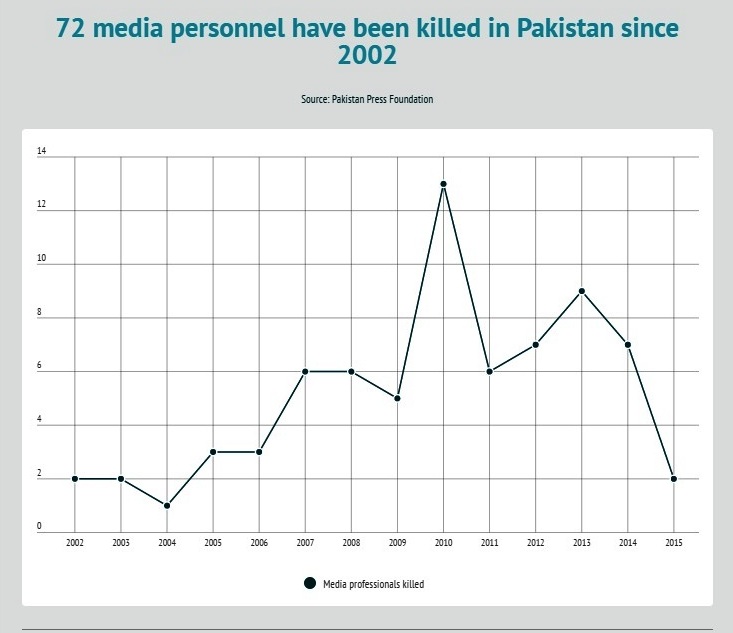
The Balochistan Union of Journalists claims 41 journalists have been targeted in the province since 2008. Much is dictated informally by the state, militants and the military, say those in Balochistan, Khyber Pakhtunkhwa and Fata.
Fresh threat
The new threat to the media comes from informal government directives on dissemination of information.
“Instructions by Pemra under the code of conduct are a disguised form of the draconian ‘press advices’, reminiscent of the Ayub era," said Ali. "The media has far more experience to allow the government to interfere in coverage. The directive to ‘act responsibly’ cannot be interpreted as asking for a blackout.”
There have been convictions to date for the murder of four journalists – Daniel Pearl, Wali Khan Babar, Abdul Razzak Johra and Ayub Khattak. Last year, Rasool Dawar stopped reporting on militancy and security issues after being detained and interrogated on multiple occasions about his stories. He refused to disclose "70% of what happened" to him, in February last year.
After threats from religious groups and militants, the Pakistani media faces a new menace
In Balochistan, a good story is not one that is well-documented by local reporters. Instead, it is one that mitigates risk. Local journalists think twice about doing stories likely to infuriate state and non-state actors, making self-censorship the norm.
Journalists are often summoned for a "cup of tea" with intelligence officials, adept at monitoring and criticising reporters, according to Zulfiqar. He has been warned a number of times against sharing his political views.
Another Baloch journalist, living in exile, explains: “It is strange living away from Pakistan yet being dominated professionally by fear. For every article I write, I spike ten others. It’s intellectual genocide. I’m not writing Jihadi literature. Jihadi supporters have all the freedom of expression, even on television. I have respect for human rights, peace and reconciliation. Why can’t I pursue my profession?”
The Balochistan Union of Journalists claims 41 journalists have been targeted in the province since 2008. Much is dictated informally by the state, militants and the military, say those in Balochistan, Khyber Pakhtunkhwa and Fata.
Fresh threat
The new threat to the media comes from informal government directives on dissemination of information.
“Instructions by Pemra under the code of conduct are a disguised form of the draconian ‘press advices’, reminiscent of the Ayub era," said Ali. "The media has far more experience to allow the government to interfere in coverage. The directive to ‘act responsibly’ cannot be interpreted as asking for a blackout.”
There have been convictions to date for the murder of four journalists – Daniel Pearl, Wali Khan Babar, Abdul Razzak Johra and Ayub Khattak. Last year, Rasool Dawar stopped reporting on militancy and security issues after being detained and interrogated on multiple occasions about his stories. He refused to disclose "70% of what happened" to him, in February last year.
After threats from religious groups and militants, the Pakistani media faces a new menace


