

The Tata Group andBharti Enterprises have held exploratory talks to evaluate a mega alliance involving their telecom, overseas cable and enterprise services, and direct-to-home TV businesses, several people familiar with the matter said.
Discussions between both sides have revolved around a possible merger between unlistedTata Teleservices and Tata Sky and the listedTata Communications with the Sunil Mittal-owned Bharti Airtel, which includes its wholly owned DTH arm, these people added.
A Tata Sons spokesperson declined to comment while the Bharti Enterprises spokesperson did not respond to ET’s emailed questionnaire.
The discussions are still at a preliminary stage and there is no certainty that this will lead to any deal.
But if the alliance does fructify, it will consolidate the Indian telecom market still further, and narrow the field down to three main players: Idea-Vodafone, Reliance Jio, and the Airtel-Tata combine.
The merger will enable Bharti Airtel, the bigger partner in the alliance, to close the gap between Idea-Vodafone both in terms of numbers of subscribers as well as revenue market share. Airtel has nearly 280 million mobile phone users in India while Tata Teleservices has around 48 million. Airtel will also get access to a ready network including 4G bandwidth in the much-sought-after 800 MHz band.
For the Tatas, the merger will provide an opportunity to fold their loss-making telecom business into a bigger company and become minority investors. The Tatas have been looking to exit the business for the last few years and in the past had also held discussions with Vodafone. The over-Rs 30,000-crore debt and its dispute with former partner NTT Docomo had, however, made any progress on this front difficult.
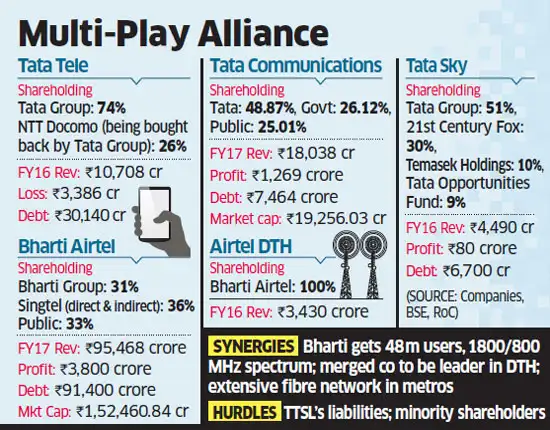
In addition, the merger will form a stronger enterprise player with a large optic-fibre network. The Tata-Bharti combine would also become a dominant leader in the DTH space, leaving Dish TV-Videocon, which is poised to become the market leader after their merger takes effect, far behind. Tata Sky with 23% and Airtel with 21% are neck and neck in subscriber market share, but the former has high-revenue customers and better satellite capacity.
In the past, both Bharti and Tatas have evaluated deal possibilities in their respective telecom and DTH businesses but these did not yield any result.
But after Ratan Tata took charge as the interim chairman of Tata Sons, following Cyrus Mistry’s ouster last October, sources say “finding a resolution for the telecom business” has been on top of the group’s agenda.
While the settlement with NTT Docomo was the first step, looking at an out-of-the-box solution for the larger telecom and media piece was the next logical step, said a person familiar with the developments. “But execution is the main problem in such a deal,” he said.
Tata Group: Tatas, Bharti on a call to explore joint front in telecom and DTH - The Economic Times
Discussions between both sides have revolved around a possible merger between unlistedTata Teleservices and Tata Sky and the listedTata Communications with the Sunil Mittal-owned Bharti Airtel, which includes its wholly owned DTH arm, these people added.
A Tata Sons spokesperson declined to comment while the Bharti Enterprises spokesperson did not respond to ET’s emailed questionnaire.
The discussions are still at a preliminary stage and there is no certainty that this will lead to any deal.
But if the alliance does fructify, it will consolidate the Indian telecom market still further, and narrow the field down to three main players: Idea-Vodafone, Reliance Jio, and the Airtel-Tata combine.
The merger will enable Bharti Airtel, the bigger partner in the alliance, to close the gap between Idea-Vodafone both in terms of numbers of subscribers as well as revenue market share. Airtel has nearly 280 million mobile phone users in India while Tata Teleservices has around 48 million. Airtel will also get access to a ready network including 4G bandwidth in the much-sought-after 800 MHz band.
For the Tatas, the merger will provide an opportunity to fold their loss-making telecom business into a bigger company and become minority investors. The Tatas have been looking to exit the business for the last few years and in the past had also held discussions with Vodafone. The over-Rs 30,000-crore debt and its dispute with former partner NTT Docomo had, however, made any progress on this front difficult.
In addition, the merger will form a stronger enterprise player with a large optic-fibre network. The Tata-Bharti combine would also become a dominant leader in the DTH space, leaving Dish TV-Videocon, which is poised to become the market leader after their merger takes effect, far behind. Tata Sky with 23% and Airtel with 21% are neck and neck in subscriber market share, but the former has high-revenue customers and better satellite capacity.
In the past, both Bharti and Tatas have evaluated deal possibilities in their respective telecom and DTH businesses but these did not yield any result.
But after Ratan Tata took charge as the interim chairman of Tata Sons, following Cyrus Mistry’s ouster last October, sources say “finding a resolution for the telecom business” has been on top of the group’s agenda.
While the settlement with NTT Docomo was the first step, looking at an out-of-the-box solution for the larger telecom and media piece was the next logical step, said a person familiar with the developments. “But execution is the main problem in such a deal,” he said.
Tata Group: Tatas, Bharti on a call to explore joint front in telecom and DTH - The Economic Times


